Playbooks Overview
Last updated: January 24, 2026
Overview
Playbooks are automated workflows that streamline your accounts receivable (AR) collection process. They allow you to define conditional logic that automatically determines what actions to take on collection conversations, such as sending emails, looping in team members, or escalating cases for manual review.
Prerequisites
A Monk account with access to the Playbooks feature
At least one customer with invoices to apply playbooks to
Collection agents configured (for automated email sending)
Understanding Playbooks
What are Playbooks?
Playbooks automate your collection workflow by evaluating conditions and executing actions. Each playbook consists of:
Conditions: Rules that evaluate invoice and conversation data (e.g., "invoice is more than 30 days overdue")
Actions: Operations to perform when conditions are met (e.g., "send collection email", "escalate conversation")
Customer Targeting: Which customers the playbook applies to
Available Condition Types
Type | Description |
Expression | Variable-based logic using invoice and conversation data |
AI | Natural language conditions evaluated by AI (e.g., "customer mentions payment plan") |
Available Actions
Action | Description |
Send Collection Email | Draft or send a collection email with configurable tone (friendly, professional, firm) |
Escalate Conversation | Flag the conversation for manual review by your team |
Loop in Email | Add recipients (like CSM or Account Manager) to future emails |
Step 1: Access Playbooks
Navigate to Playbooks from the main navigation menu. You'll see the Playbooks page with two tabs:
My Playbooks: Lists all playbooks you've created
Templates: Pre-built playbook templates for common scenarios
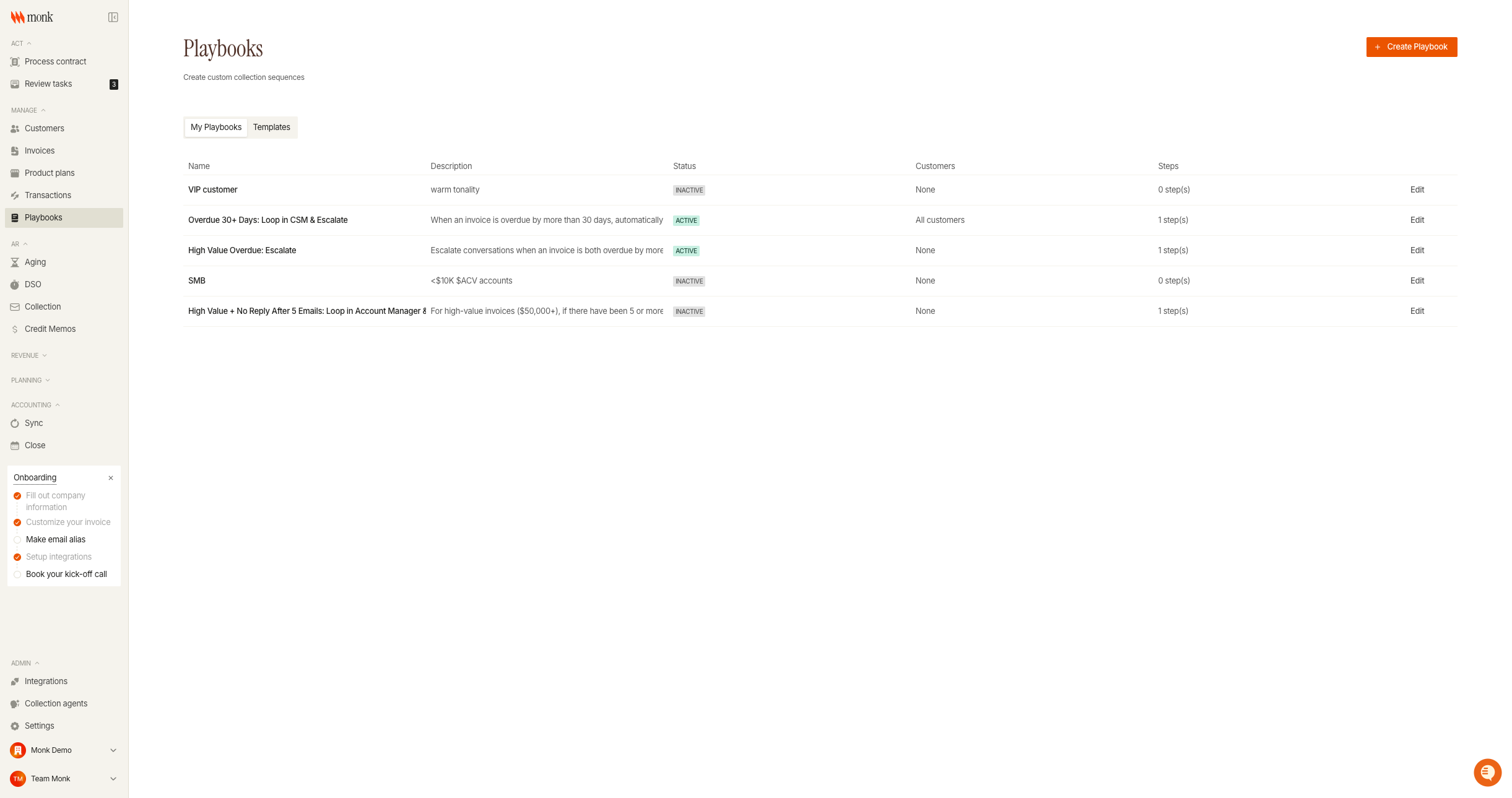
The list shows:
Playbook name and description
Status (Active/Inactive)
Assigned customers
Number of workflow steps
Step 2: Browse Templates
Click the Templates tab to view pre-built playbook templates organized by category.
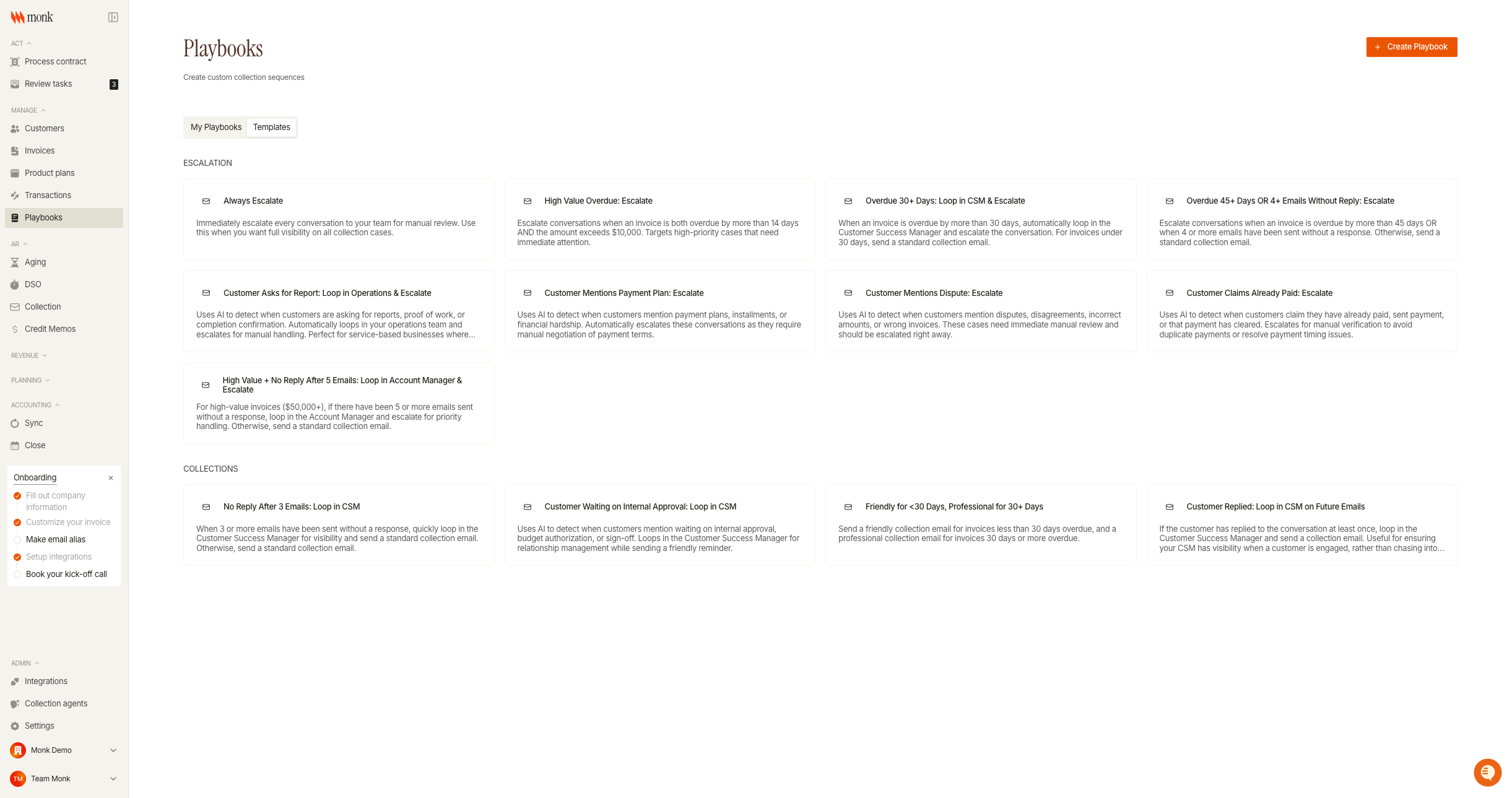
Escalation Templates
Templates that end with escalating conversations for manual review:
Always Escalate: Immediately escalate every conversation
High Value Overdue: Escalate: Escalate when invoice exceeds $10,000 and is 14+ days overdue
Overdue 30+ Days: Loop in CSM & Escalate: Loop in CSM and escalate for invoices 30+ days overdue
Customer Mentions Payment Plan: Escalate: AI detects payment plan mentions
Customer Mentions Dispute: Escalate: AI detects dispute mentions
Customer Claims Already Paid: Escalate: AI detects "already paid" claims
Collection Templates
Templates focused on sending collection emails:
No Reply After 3 Emails: Loop in CSM: After 3 unanswered emails, CC your CSM
Friendly for <30 Days, Professional for 30+ Days: Adjust email tone based on overdue period
Customer Replied: Loop in CSM on Future Emails: CC CSM when customers engage
Step 3: Create a Playbook
Option A: Create from Scratch
Click Create Playbook button
Fill in the playbook details:
Playbook Name: A descriptive name (e.g., "High Value Overdue Follow-up")
Description: What this playbook does
Customers: Choose "All customers" or select specific customers
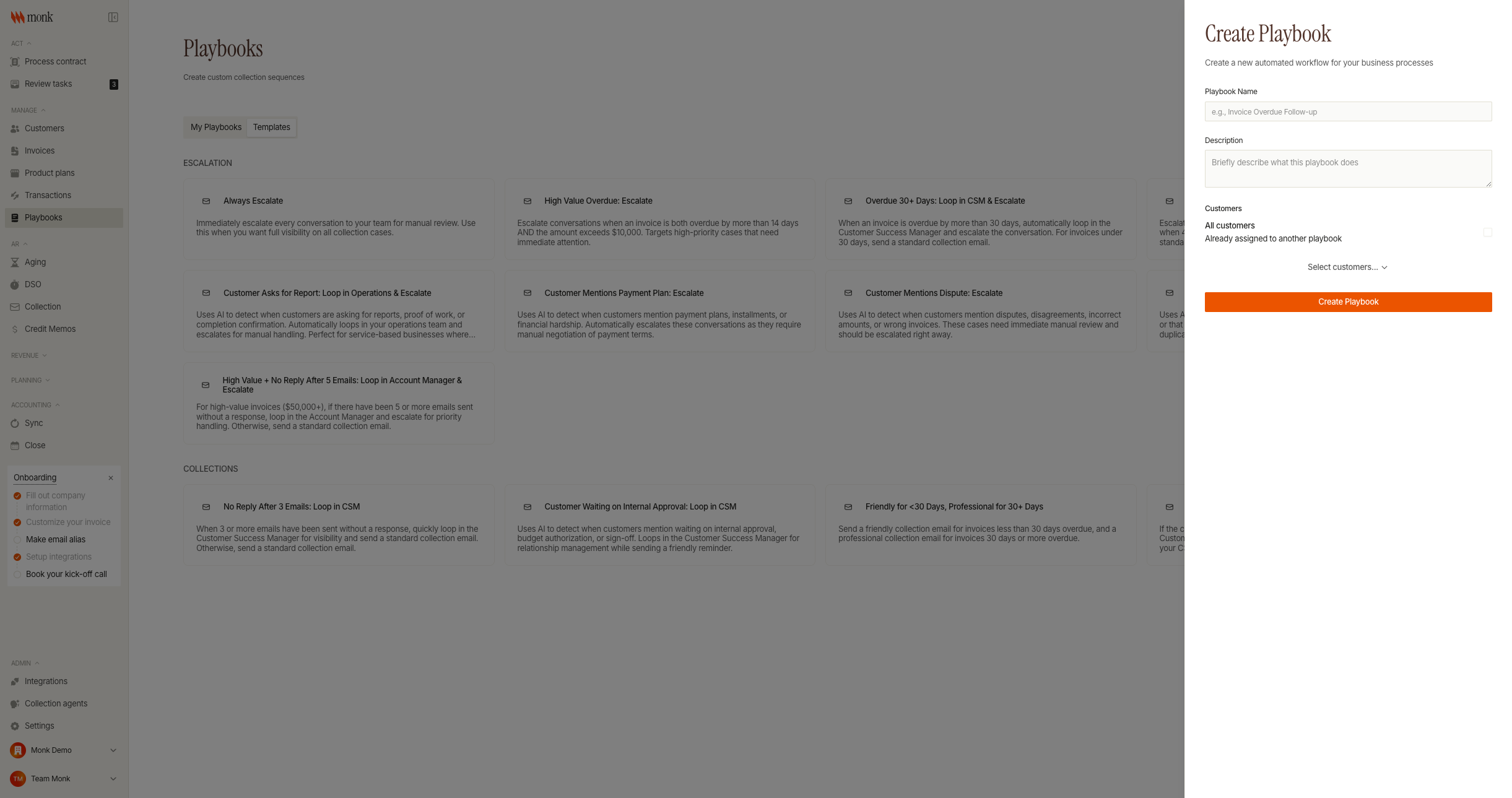
Click Create Playbook to proceed to the workflow editor
Option B: Create from Template
Go to the Templates tab
Click on a template card that matches your use case
The create form opens with pre-filled name and description
Adjust the name and customer targeting as needed
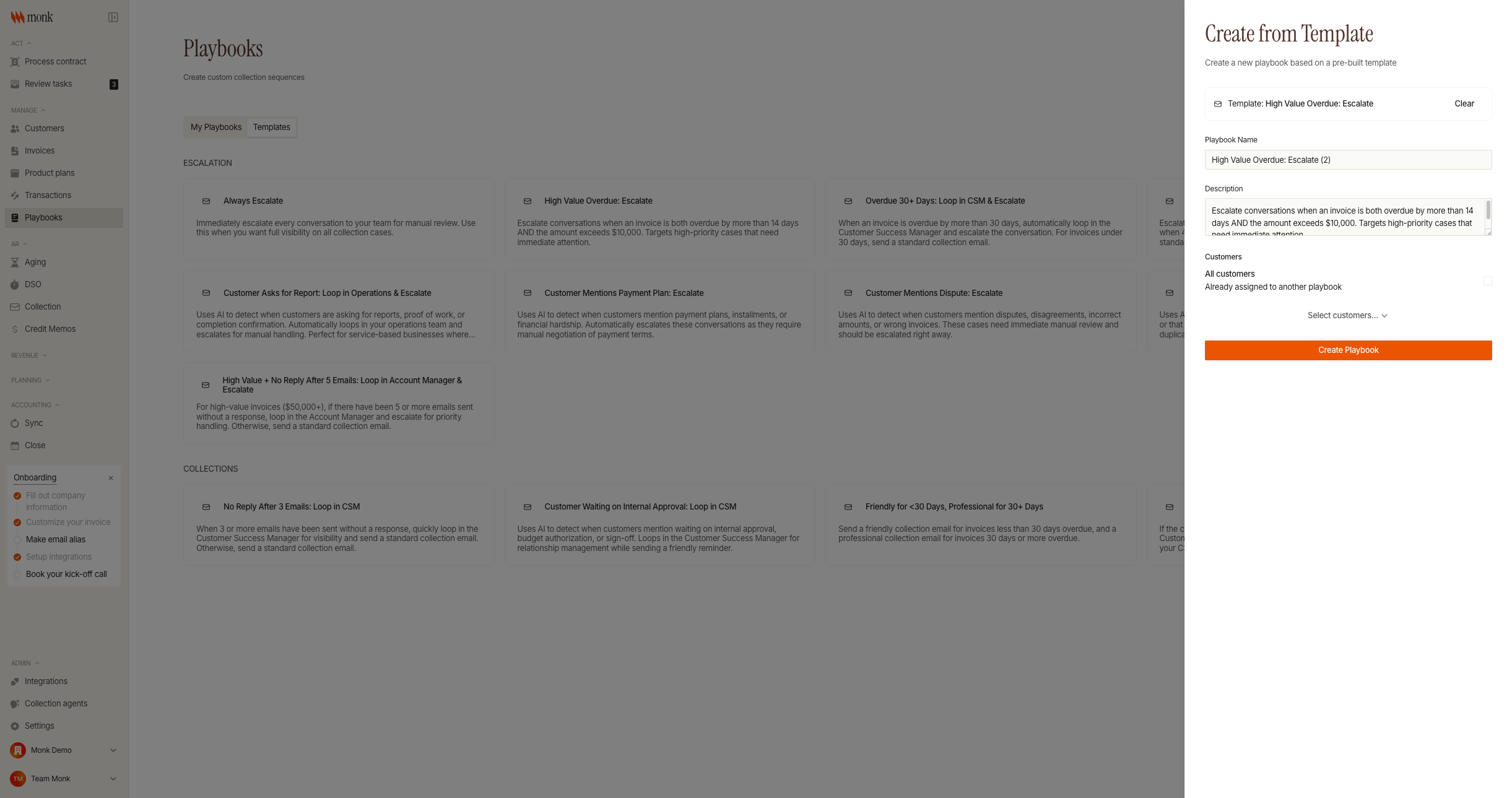
Click Create Playbook to create with the template's pre-configured workflow
Step 4: Edit Playbook Settings
To modify an existing playbook's settings:
Find the playbook in My Playbooks list
Click Edit on the row
Update the name, description, or customer assignment
Click Save Changes
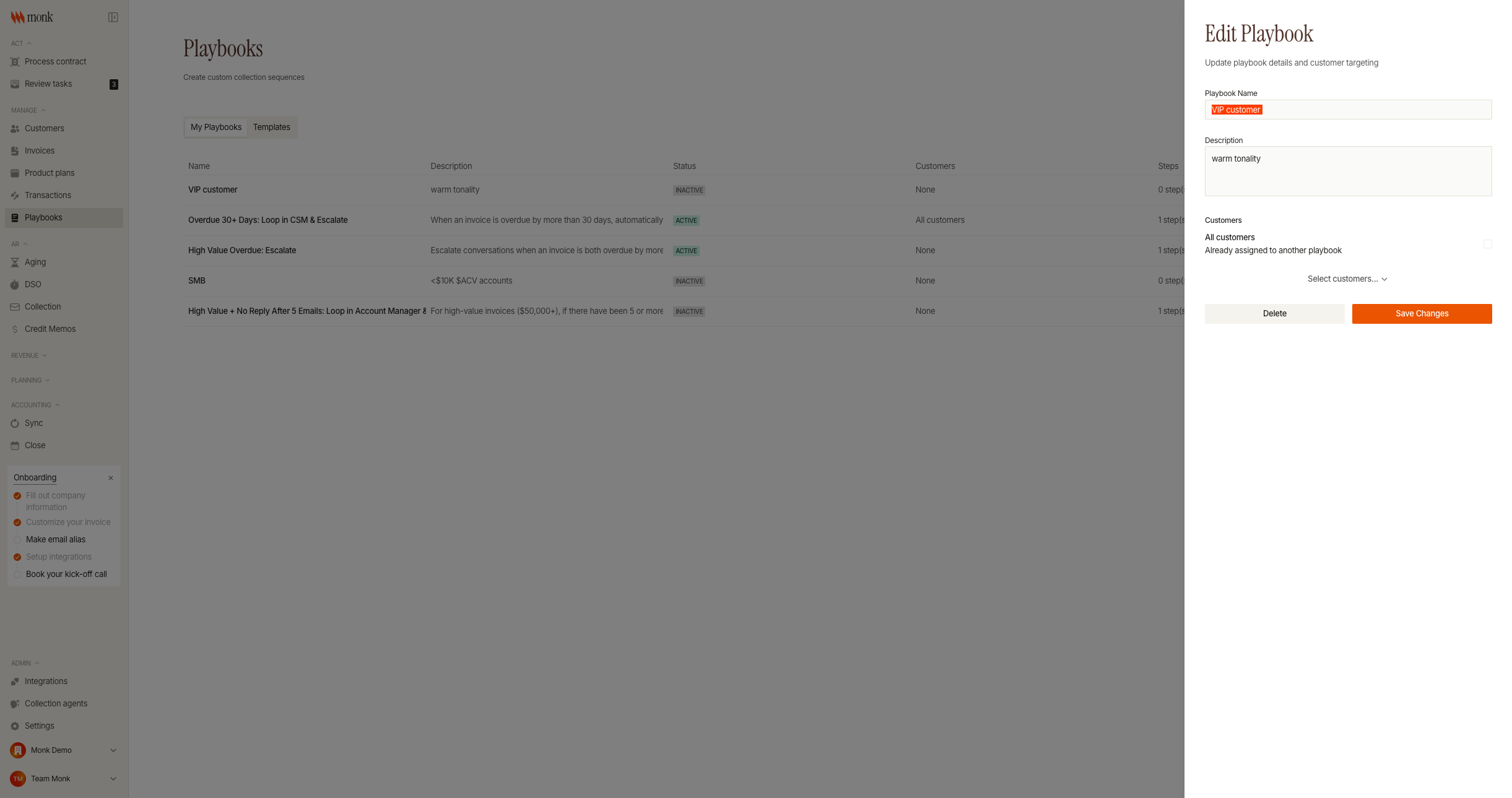
Note: To modify the workflow steps, click on the playbook row to open the workflow editor.
Step 5: Configure Workflow Steps
After creating a playbook, you'll be taken to the Workflow Editor where you can configure the conditional logic and actions.
The Workflow Editor
The editor provides:
Nested View: Traditional tree view showing condition branches
Flow View (Beta): Visual flowchart representation
Configuration Sidebar: Edit details of selected steps
Adding Conditions
Click Add Step > Add Condition
Choose condition type:
Expression Condition
AI Condition
Configure TRUE and FALSE branches with actions or nested conditions
Adding Actions
Within each condition branch:
Click Add Step in the TRUE or FALSE section
Select an action:
Escalate Conversation: Flags for manual review
Send Collection Email: Configure tone and additional recipients
Loop in Email: Add CC recipients
Step 6: Test Your Playbook
Before activating, test your playbook to verify it works as expected:
Save your changes
Click Test dropdown
Select a customer (or let it choose randomly)
Review the test results showing which conditions evaluated to true/false and what actions would be taken
Note: Testing runs in dry-run mode - no actual emails are sent or conversations modified.
Step 7: Activate Your Playbook
Once satisfied with your configuration:
Ensure all workflow steps are complete (no empty conditions)
Click Activate to enable the playbook
The playbook will run automatically during scheduled collection cycles
To pause a playbook, click Deactivate. This stops execution without deleting your configuration.
Troubleshooting
Playbook not running on expected customers
Cause: Customer assignment conflicts or inactive status
Fix:
Check that the playbook is set to Active
Verify customer targeting includes the expected customers
Note that customers can only be in one playbook at a time
"Cannot activate playbook without steps" error
Cause: Playbook has no configured workflow steps
Fix: Add at least one condition or action step before activating
Collection emails not being sent
Cause: Conversation already escalated or resolved
Fix:
Check if the conversation has been manually escalated
Review the action ordering - emails cannot follow escalation
Verify your collection agent settings
AI conditions not evaluating correctly
Cause: Prompt may be ambiguous or not matching customer responses
Fix:
Make your AI prompt more specific
Use the Test feature to see how conditions evaluate
Consider using expression conditions for precise numeric thresholds
Best Practices
Start with templates: Use pre-built templates as starting points, then customize
Test before activating: Always run tests with real customer data
Use appropriate escalation thresholds: Don't escalate too early or too late
Combine AI and expression conditions: Use AI for nuanced detection, expressions for hard thresholds
Document your playbooks: Use clear names and descriptions
Review regularly: Adjust playbooks based on collection performance